|
Exciting research projects are being initiated at the Bell Observatory.
by Michael Carini
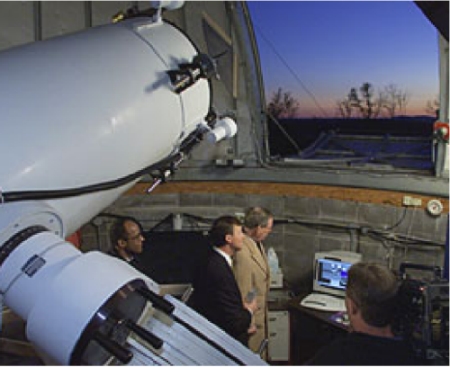
One of the best kept secrets on The Hill is WKU's 0.6m (24")
telescope. Having recently been refurbished, thanks to a grant from
NASA, the telescope is now embarking on a new era of scientific
investigation and discovery.
The Bell Observatory, located on a hilltop 12 miles southwest of
Bowling Green, has been operating since 1988, to support astronomy
classes and for hands-on student training activities. Advances in
telescope control systems and computing equipment now allow WKU's
telescope to be operated in a fashion similar to telescopes at
international observatories.
 Bell Observatory is part of a larger project known as STARBASE:
Students Training for Analytical Space Sciences Experiences. STARBASE
will network telescopes sited around the world with students and
faculty across the country and with high school students and teachers
from Kentucky, the surrounding region and across the nation. WKU's
0.6m telescope is the first node in this network of robotic
observatories. The telescope can be operated manually, with observers
in the dome, or remotely from a control room in TCCW. Four of our
Physics majors (Whitney Wills, Ashley Atkerson, Tala Monroe and Wes
Ryle) are operating the telescope during the week.
Bell Observatory is part of a larger project known as STARBASE:
Students Training for Analytical Space Sciences Experiences. STARBASE
will network telescopes sited around the world with students and
faculty across the country and with high school students and teachers
from Kentucky, the surrounding region and across the nation. WKU's
0.6m telescope is the first node in this network of robotic
observatories. The telescope can be operated manually, with observers
in the dome, or remotely from a control room in TCCW. Four of our
Physics majors (Whitney Wills, Ashley Atkerson, Tala Monroe and Wes
Ryle) are operating the telescope during the week.
The telescope is currently making observations designed to support
two research projects. The first of these is a search for extra-solar
planets, lead by Dr. Charles McGruder. Under this program we are
looking for brightness changes in stars which indicate that the planet
has passed between us and the star.
Our second program is also looking for brightness variations,
though not in stars. Led by Dr. Michael Carini, this project is
looking for changes in brightness in a class of quasar called BL
Lacertae objects. The objects are the cores of galaxies which are
emitting jets of material moving towards us at speeds nearly the speed
of light. Because the objects are at great distances from us, they are
also some of the oldest objects in the universe. By studying their
brightness variations, we hope to learn more about the process
operating inside the jets.
|